
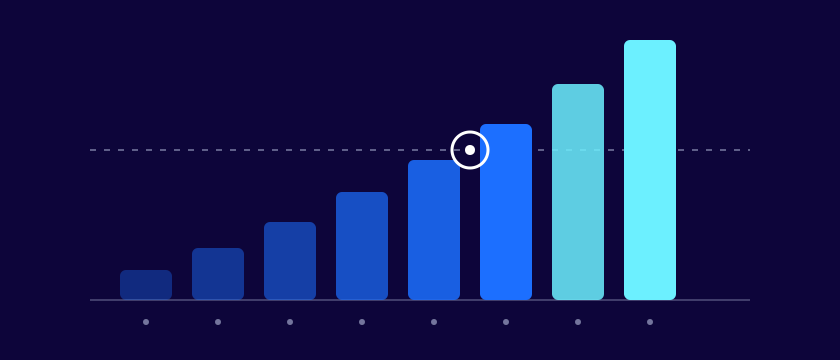
“When will it pay off?” is the question people ask at a demo about the first scenario. It is more accurate to ask it about the platform as a whole. The economics of custom projects are linear: each new process costs roughly the same as the previous one, because everything is built from scratch every time. The economics of a platform are cumulative: the most expensive part is built once, and every new scenario latches onto what is already in place. That difference is what produces a payback within 6–9 months, and we will break it down piece by piece, with numbers.
What launching the first scenario consists of
Take a typical first scenario: analyzing sales-team calls with automatic record keeping. The work splits into two unequal parts.
The fixed part: connecting to telephony and CRM, setting up access permissions, configuring orchestration – which events trigger what, the action log, the deployment environment and sign-offs with the security team. In our reviews we see that this accounts for 60–70% of all the effort of the first launch. This work has nothing to do with the scenario itself: it is equally necessary for calls, documents and reporting.
The variable part: training the agent on your examples, terminology, process logic, checkpoints, acceptance runs. That is the remaining 30–40%. Together the two parts take from 8 weeks to production, because on the platform the fixed part is not written from scratch but assembled from ready-made blocks.
What changes on the second scenario
Everything that was paid for with time on the first launch is already in place. Integrations with telephony and CRM work. Permissions are configured. The security team asked its questions and got its answers – the action log and the security model are agreed. The team has seen the agent in action and is no longer afraid of it.
All that remains is the variable part: configuring a new scenario on top of the ready-made plumbing. Instead of eight to twelve weeks, three to four. Instead of a full sign-off cycle, a short acceptance. The third scenario goes even faster: the team gains experience labeling examples and formulating rules.
| First scenario | Second | Third | |
|---|---|---|---|
| Integrations and permissions | being built | ready | ready |
| Security sign-off | full cycle | delta check | delta check |
| Scenario configuration | 4–5 weeks | 3–4 weeks | 2–3 weeks |
| Time to production | from 8 weeks | 3–4 weeks | 2–3 weeks |
In the project model this table does not exist: there, the second scenario is a second estimate of 30–60 million ₸, which we worked through in detail in the comparison of subscription and project.
The arithmetic of 6–9 months
A platform subscription starts from 12 million ₸ per year – a million a month. A first scenario with sound economics delivers 1.8–2.2 million ₸ of effect per month once it reaches the plateau: hours saved plus a lift in the process result. The plateau does not arrive instantly – launch takes two months, and the agent spends another month building quality on the live stream.
A year of subscription 12 million ₸ ÷ effect 2 million ₸/mo ≈ 6 months → allowing for 2–3 months of ramp-up, 8–9 months to full payback
Now let us add a second scenario in the fourth or fifth month. The subscription did not go up. Configuration took three weeks. The platform effect becomes 3–3.2 million ₸ per month, and the payback point shifts left, toward the sixth or seventh month. That is where the 6–9 range comes from: its lower bound is reachable precisely thanks to the second scenario, not thanks to heroics on the first.
A mini-scenario: calls, then support quality
The pattern we most often assemble in reviews for companies with a high call volume. First to launch is sales-call analysis: the agent listens to recordings, keeps records, monitors scripts – the telephony and CRM integration is built for it. A quarter later those same integrations find a second job: quality control of support conversations – scoring every conversation against a checklist, native-level Kazakh and Russian, escalating problem dialogues to a senior team member.
Configuring the second scenario would take three weeks: telephony is already connected, permissions are already mapped out, only the scoring logic changes. Yet the effect is comparable to the first scenario – a supervisor's spot check of 5% of calls turns into full coverage. This mechanism is covered in more detail in the customer support solution.
What speeds up payback – and what kills it
Speeds it up: a frequent operation with measurable timing, a metric owner with authority, a second scenario on the same integrations, readiness to hand the agent real data from the first week. A prototype works for speed here too: a week on your examples, free of charge, so the launch starts from a tested hypothesis rather than from hope.
Kills it: trying to launch everything at once and stretching the fixed part over six months, a rare process with an effect once a quarter, the absence of an owner – when no one puts the saved hours to work. We covered the calculation traps separately, in the article on mistakes in calculating the effect.
Frequently asked questions
Why can't you calculate the payback of each scenario separately?
Because the subscription is for the platform, not for a scenario. Dividing its cost onto the first scenario means overstating its price; scenarios share the subscription among themselves, and the more of them there are, the faster the whole thing pays off. You have to count the portfolio, not the episode.
How many scenarios can you realistically launch in the first year?
Usually two to four: the first from 8 weeks, the rest at three to four weeks each, with pauses for acceptance and team training. We do not advise going faster: every scenario needs a metric owner, and people need time to get used to a new routine.
What to do if the first scenario does not reach payback?
First, check the calculation: most often the second term is forgotten – the lift in the process result. If the economics honestly do not add up, the scenario is worth changing before the contract rather than after: a free week-long prototype exists precisely so that the cost of a wrong choice is zero tenge.