The meeting ended at eleven thirty. The minutes will appear on Thursday, after two rounds of reconciling the wording. Of six assignments, two will be lost along the way: one because the person responsible understood the deadline differently, the other because it will only be remembered the day before the report to the board. Familiar to most quasi-public sector organizations whose processes we have walked through.
Here documents are not a byproduct of the work, they are the work itself. Minutes, assignments, orders, regulatory acts, tender documentation, letters to the shareholder and to the ministry. The volume grows, the headcount does not. Let us look at four processes where the platform takes over the most manual labor, and show how it coexists with your EDMS and your security requirements.
Four processes where weeks are lost
The first is meetings. A mid-level manager at a national company spends 12 to 18 hours a week in meetings; each one trails a set of minutes that someone has to write, reconcile and distribute. The second is assignments: there are hundreds a month, and tracking their execution rests on the discipline of the secretariat and reminders in messaging apps.
The third is regulation. Changes to regulatory acts come out constantly, and someone has to notice in time that a new edition affects internal regulations. The fourth is tender documentation: volumes running several hundred pages, from which lawyers and engineers pick out requirements by hand and assemble a bid.
What all four share is that they are working with text according to rules. That is exactly what the platform does best.
There is a fifth layer as well: correspondence. Ministry inquiries, letters from the shareholder, incoming requests. We do not treat it as a separate process, because technically it is the same task: find the grounds, gather the facts, draft a reply from a template and not miss the deadline.
Minutes and assignments from a meeting recording
A scenario from a prototype for one of the quasi-public sector organizations. A weekly production meeting, fifty minutes, mixed speech – Kazakh and Russian interleaved, as usual. The secretary used to spend half of the next day on the minutes. Now the meeting recording goes into the platform, and fifteen minutes later a draft is ready: the agenda, the decisions, the assignments – each with an owner, a deadline and wording matching the organization's template.
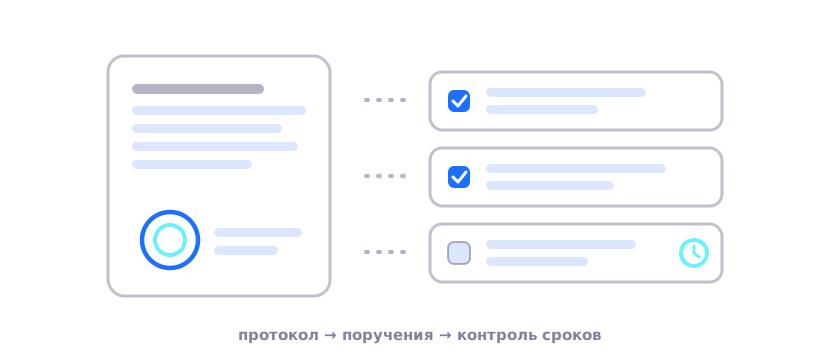
A person reviews the draft. This is fundamental: the platform prepares the document but does not sign it. The secretary corrects the wording of one item, the chair approves it, and the assignments go into the EDMS as individual cards. If the EDMS has an API, the cards are created directly; if not, the agent enters them through the interface, using the same screens as a records clerk. Manual work in this chain amounts to about ten minutes instead of half a day.
A side effect that participants in one of the prototypes told us about: the discipline of the meetings themselves improved. When decisions are recorded verbatim and immediately, there is noticeably less need to argue about what was meant.
How do you keep from losing assignments after the minutes?
An assignment is lost not at the moment it is set, but in the silence between the setting and the deadline. The platform removes that silence with events: three days before the deadline the person responsible gets a reminder with the assignment text and a link to the card; on the due date with no report – a notification to the manager; once overdue – an escalation along a predefined chain.
Once a week the manager receives a summary of execution discipline: how many assignments are in progress, what is closed, what is on fire, whose deadline extensions are piling up. Not a presentation that took two days to prepare, but a snapshot that assembled itself. In our reviews we often hear the same phrase: "we have this in the EDMS, but nobody looks in there." The difference is that the platform does not wait until someone looks – it comes to you on its own and for a specific reason.
Assignments that arise outside meetings – in resolutions on letters, in orders – enter the same loop: the platform reads the document, finds the assignment, the deadline and the owner, and puts it under control together with the rest.
What does AI do with regulatory acts and tender documentation?
A mini-scenario on regulation. A change to an industry regulatory act comes out. The platform tracks the sources, finds the new edition and compares it with the previous one: which articles changed, which internal regulations and instructions reference them. The legal team receives not a "please read the new edition" but a list: three documents affected, here are the clauses, here are the proposed assignments to the responsible units. The check takes an hour instead of a week of manual monitoring.
With tender documentation the logic is the same, the scale is different. The platform breaks down a volume of six to eight hundred pages in a matter of hours: qualification requirements, technical specification, deadlines, bid security, evaluation criteria – all consolidated into a compliance checklist. The procurement specialist checks the checklist against links to pages in the volume, rather than reading it through with a highlighter. The risk of missing a requirement that would get the bid rejected drops several times over.
The "before" cost here is easy to measure. In one review the legal team estimated regulatory monitoring at six to eight hours a week per specialist, and going through a single tender volume at two to four days. The platform does not replace expertise – it removes the reading of everything indiscriminately for the sake of three relevant paragraphs.
| Process | Manually | With the platform |
|---|---|---|
| Meeting minutes | 0.5–2 days with reconciliations | draft in 15 minutes, reviewed by a person |
| Setting assignments in the EDMS | cards entered one by one | created from the minutes automatically |
| Deadline control | manual reminders, near the reporting date | events: reminder, escalation, summary |
| Tender documentation volume | 2–4 days of specialist work | checklist in hours plus a review |
| Monitoring regulatory changes | after the fact, once noticed | regularly, tied to regulations |
Savings = secretariat hours on minutes + lawyer hours on regulation and tenders + assignments closed on time
Plug in your own numbers: eight regular meetings a week is on the order of 80 secretariat hours a month; regulatory monitoring is another 25 to 30 lawyer hours; each tender volume is days of specialist time. The total usually surprises even the people who run these processes.
How does the platform fit into the EDMS and the security perimeter?
The question that begins every conversation in the quasi-public sector is not "what can the platform do" but "where will our documents go." The answer: nowhere. Processing happens inside the organization's perimeter, the documents never leave it. Access is separated by role – the agent sees exactly the documents that the employee whose routine it took over would see.
Every action the platform takes is written to a log: which document was read, which card was created, who received a notification. For organizations with internal audit and a security team this is a condition of access, and we built it into the architecture from the very start – more on this in the article on data inside the perimeter.
Integration does not require changing your landscape. The EDMS, accounting systems, mail, file storage connect via API; where there is no API or it is closed, the agent works through the system's interface. For the common domestic EDMS platforms both paths are proven.
Where an organization should start
It makes sense to start with meetings and assignments: the process hurts everyone, the result is visible within a week, and the integration is minimal. For a prototype, two or three meeting recordings and examples of your minutes are enough – within a week we tune the platform to the organization's template, free of charge. The secretariat compares the drafts with what it wrote by hand, and the decision to continue is made on the facts.
A production rollout with EDMS integration and configured escalation chains takes from eight weeks, after which comes the subscription. The second scenario – regulation or tenders – connects to the same platform noticeably faster than the first: the integrations and permissions are already built. What the solution includes is on the AI for the quasi-public sector page; to discuss your own organization, get in touch through our contacts.
Frequently asked questions
We have a closed perimeter and our own EDMS – is this compatible?
Yes. The platform is deployed inside the organization's perimeter and works with whatever EDMS is in place: via API, and in its absence through the interface. Documents are not sent outside, which is documented in the solution architecture and verified by your security team. The prototype, meanwhile, can be run on anonymized recordings – even before access to the perimeter is granted.
Meetings run in Kazakh and Russian interleaved – will it recognize that?
It will: both languages are processed at a native-speaker level, including mixed speech, with speaker attribution. The minutes are then formatted in the organization's language of record – regardless of the language in which the discussion was held.
Who is responsible for the wording in the minutes?
A person, as before. The platform prepares the draft and the draft assignments, but the secretary and the chair approve them – until then nothing goes to the EDMS or to the people responsible. The control point with confirmation is built into the process deliberately.